|
|---|


Thursday, May 5, 2011


Base price is £59,925 for the normally aspirated model and £71,675 for the Supercharged version.
The Farbio GTS is mid-engine ranging from a 262bhp normally aspirated model with 0-60mph in 4.8 seconds (est), up to 384bhp for the Rotrex Supercharged version with 0-60mph in 3.9 seconds (est).
The Farbio GTS has an impressive power-to-weight ratio of 360bhp per ton (250bhp per ton for the normally aspirated car). It is lightweight, weighing in at a nimble 1066kgs for the Supercharged model and 1048kgs for the normally aspirated version.
Brakes are AP Racing with Four Pot Callipers, 350mm vented front discs and 328mm rear, giving immense braking capabilities.
Suspension is fully adjustable dampers with Eibach coil-over springs to give the car an exciting, precise driving experience - a feature omitted from many modern day sports cars.
Farbio GTS customers will be able to tour in comfort with the spacious, ergonomic interior, with fully adjustable Sparco reclining seats allowing for a 6'6" driver. The controls have an easy accessibility with the touch-screen featuring satellite navigation, air conditioning and sound system as standard.
Long distance touring is made easier due to the 76 litre fuel tank and 220 litre boot capacity, which can incorporate a full size set of golf clubs or luggage.
Wednesday, April 13, 2011


Trevita is an abbreviation in Swedish and translates into - three whites. The Koenigsegg visible carbon weave body work is renowned around the globe for its perfection and uniqueness. However, so far it has only been possible to utilize the classic black carbon fibres.
As Koenigsegg always strives to create new unique technologies and solutions, we have now reached a new milestone - The Koenigsegg Proprietary Diamond Weave.
By utilising a new and unique method, Koenigsegg has managed to coat fibers with a diamond finish. The process was fully developed at Koenigsegg headquarters in Ängelholm Sweden, where the fiber treatment is conducted carefully in small quantities, prior to further processing the prepreg material.
Koenigsegg will only produce three Koenigsegg CCXR Trevitas in total, hence the name. This makes the Trevita one of the most rare versions in the Koenigsegg family cars.
The three cars are fully equipped with Koenigsegg Shimmering Diamond Weave bodywork, double carbon wing, paddle-shift, inconell exhaust system, carbon ceramic brakes with ABS, hydraulic lifting system, infotainment system, tyre monitoring system, chrono instrument cluster and airbags.
Thursday, March 17, 2011


Completely redesigned for 2008 with increased dimensions for a more spacious interior, the sedan styling theme expresses a powerful presence with sharp and strong character lines. The coupe is further individualized with an aggressive stance and unique proportions that create a muscular, sporty demeanor.
Sedan trim levels range from the well-equipped Accord Sedan LX and plus-featured LX-P (177-horsepower 4-cylinder engine), to the nicely-equipped Accord Sedan EX (190-horsepower 4-cylinder engine or 268-horsepower V-6 engine), to the premium and upscale Accord Sedan EX-L (190-horsepower 4-cylinder engine or 268-horsepower V-6 engine). Coupe trim levels range from the well-equipped Accord Coupe LX-S (190 horsepower 4-cylinder engine), to the nicely-equipped Accord Coupe EX (190-horsepower 4-cylinder engine) to the premium and upscale Accord Coupe EX-L (190-horsepower 4-cylinder engine or 268-horsepower V-6 engine).
Interior
Premium quality with a simple, modern and spacious design describes the philosophy behind the Accord's interior. The larger Accord Sedan total interior volume of 120.0 cubic feet (+3.3 cubic feet compared to 2007) moves the EPA classification from the midsize sedan class to the large sedan class. The additional space is intended to provide "equal" seating comfort for front and rear passengers. Rear legroom of 37.2 inches (+0.4 inches) approaches the impressive second row legroom of the Honda Pilot SUV (37.4 inches). The wider interior (+1.5 inches) allows the front seats to be positioned farther apart to allow for a wide center console more commonly associated with the finest luxury vehicles.
Intended to convey a prestigious presence, the Accord Sedan embraces a traditional three-box shape that emphasizes both a dynamic and athletic feel with the sophistication of a timeless sedan form. Dimensionally, the Accord Sedan's overall length of 194.1 inches (4-cylinder models, V-6 models add 0.2 inches for front spoiler lip) is 3.0 inches longer than the 2007 model. The width of 72.7 inches is 1.1 inches wider, and the height of 58.1 inches is 0.9 inches taller. Even though the size is larger in every dimension, the vehicle's torsional rigidity has increased by 20 percent as a result of advanced body construction that uses 48 percent high-tensile steel - the most high-tensile steel by volume of any Accord to date. A significant benefit to the advanced body construction is that total vehicle weight increased only by approximately 5 percent despite the larger size, greater rigidity and added features.
The Accord Coupe styling radically breaks from the sedan with a uniquely aggressive image. Its long hood, sleek roofline and muscular lines suggest power and a heightened agility compared to the sedan. Dimensionally, the Accord Coupe's overall length of 190.9 inches is 3.2 inches longer than 2007 model, its width of 72.8 inches is 1.2 inches wider, and its height of 56.4 inches is 0.6 (LX-S) to 0.7 (EX, EX-L) inches higher. Compared to the 2008 Accord Sedan, the Accord Coupe is 3.2 inches shorter in length, 1.7 inches shorter in height and 0.1-inch wider.
Powertrain
All 2008 Accord engines deliver increased horsepower across the board, along with high fuel efficiency and low emissions. In total, these power plants represent the most powerful and advanced technologies of any Accord in history, and are also projected to deliver excellent real-world fuel economy performance. All engines only require regular unleaded fuel. Powertrain highlights include:
* 2.4-liter, DOHC, i-VTEC 4-cylinder engine (Sedan LX, LX-P)
o 177 horsepower at 6500 rpm, 161 lb-ft. of torque at 4300 rpm
o 5-speed automatic transmission or 5-speed manual transmission
o Estimated EPA fuel economy of 21/31 mpg City/Highway (Sedan, Automatic)
o PZEV or ULEV-2 emissions
* Accord Sedan EX, EX-L; Coupe LX-S, EX, EX-L includes:
o High-flow exhaust system with variable-valve silencer
o 190 horsepower at 7000 rpm, 162 lb-ft. of torque at 4400 rpm
* 3.5-liter, SOHC, i-VTEC V-6 engine (Sedan EX V-6, EX-L V-6; Coupe EX-L V-6: 5AT)
o 268 horsepower at 6200 rpm, 248 lb-ft. of torque at 5000 rpm
o 5-speed automatic transmission
o V CM for improved fuel efficiency
o Estimated EPA mileage of 19/29 mpg City/Highway (Sedan)
o PZEV or ULEV-2 emissions
* 3.5-liter, SOHC, VTEC V-6 engine (Coupe EX-L V-6: 6MT)
o 268 horsepower at 6200 rpm, 248 lb-ft. of torque at 5000 rpm
o 6-speed manual transmission
o VTEC provides two intake cam profiles for increased low- and mid-range torque
o Estimated EPA mileage of 17/25 mpg City/Highway
o ULEV-2 emissions
Monday, February 7, 2011


Invicta has evolved from Buick concepts such as the 2004 Velite convertible and 2007 Riviera coupe, both of which received accolades for their thoroughly modern adaptation of classic Buick themes. Invicta was designed collaboratively by GM centers of expertise in Warren, Mich. and Shanghai, China. The name, which is Latin for "invincible," returns to Buick after a 45-year hiatus in the United States.
Invicta is powered by Buick's first direct injection turbocharged engine, a four-cylinder powerplant that produces 250 horsepower (186 kW) and 220 lb-ft (298 Nm) of torque. The engine is matched with a six-speed automatic transmission for maximum fuel efficiency.
Modern, sleek exterior
Invicta's designers drew inspiration from the Riviera concept. Invicta features modern and sleek proportions with exterior lines that flow uninterrupted around the vehicle. For example, Invicta's cat-eye headlamps transition into the Buick heritage-inspired sweepspear design cue, which flows seamlessly along the body sides and merges into the taillamps. Similarly, one can trace the top of the headlamp casing to the roofline and the rear of the vehicle without interruptions.
As with Riviera, Invicta features short overhangs with wheels pushed out to the corners for a well-planted stance. The overall appearance is sleek, thanks in part to a sweeping, low roofline and a front windshield that has an aggressive rake.
Up front, the Buick tri-shield is prominently displayed inside the Velite-inspired chrome vertical waterfall grille. Polished aluminum surrounding the headlamps, portholes, around the D-pillar and along the lower side of the vehicle on the lower doors accentuates the overall exterior design. Reminiscent of a number of historic Buick models, Invicta's portholes - three per side - are located on the hood rather than on the front quarter panels.
Invicta's wheelbase and high belt line give the vehicle more substantial proportions while visually reinforcing its premium appearance. Invicta's 20-inch polished aluminum wheels feature a milled Buick tri-shield in the center cap.
To signal its premium attributes while enhancing the vehicle's sleek proportions, Invicta's exterior is draped in a sumptuous AluStone color. Its warm beige tone contains wafer-thin flakes of aluminum that reflect light to emit a liquid gold appearance.
Flowing, crafted interior
The focus and attention to seamless transitions carry over inside Invicta. The doors merge to become one with the instrument panel, which morphs into the center console.
The wrap-around design of the interior and fluid design provide a spacious cabin for all passengers, especially those seated in the back of the vehicle. At nearly 100 cubic feet of interior space, Invicta delivers large-car comfort in a mid-size sedan. The sense of roominess is further accentuated by a full glass roof, which allows all passengers to enjoy the sights, day or night.
Invicta also showcases a high level of interior craftsmanship while creating an environment that is soothing, quiet, comfortable and inviting for all passengers.
The blending of premium materials - such as wood trim and polished aluminum accents, soft aniline leather, supple suede-like material and soothing Light Emitting Diode (LED) lighting technology - encase passengers in Buick luxury.
Beyond its sumptuous appearance, Buick created a show car for the senses. Authentic French seam stitching on the soft-touch instrument panel pad, door panels and steering wheel invites touch. Buttons, switches and door pulls are crafted to deliver a tactile quality experience. Soft and soothing Ice Blue ambient LED lighting on the instrument panel, around the central vehicle function controls, along the console and center storage, and in the front footwells provoke visual sophistication. Two discriminating "spotlights" also accent the center point of the front and rear seats.
Monday, January 31, 2011


The 2008 Cadillac STS, featuring refreshed signature styling inside and out; a new, standard 298-horsepower (222 kW) V-6 engine; and a host of new vehicle technologies, debuts at New York Auto Show, April 6-15, at the Jacob Javits Convention Center.
Refreshed design, inside and out
With overall dimensions slightly increased, the new STS conveys more of the design flair that has become a Cadillac signature. Up front, the dual-textured, multi-faceted grille first seen on the Sixteen concept and incorporated on both the Escalade and soon-to-be-launched 2008 CTS, has been adapted to the STS, giving the luxury performance sedan a more sophisticated appearance. Vertically stacked headlamps with large, dual 70mm projector lenses are encased in an aluminized, single-piece bezel. High Intensity Discharge (HID) headlamps are now available on V-6 models.
Similarly, side air extractors, again inspired by the Sixteen and Escalade, are now incorporated in the front fenders of the STS.
New styling touches also include chrome-plated door handles and new lower rocker moldings that blend into the lower line of the vehicle for more presence and refinement.
At the rear, the new fascia is now body-color, and is highlighted with the addition of polished, aluminum three-inch exhaust tips.
New, polished 18-inch by 8-inch aluminum 14-spoke wheels are available. For these available wheels, Michelin W-rated, 235/50R18 tires are used up front, and the rear wheels are fitted with 255/45R18 all-season radials.
Inside, STS's luxurious interior includes a new steering wheel with available genuine Sapele Pommele wood trim. Sapele is an exotic wood more commonly used in fine furniture and musical instruments. A heated steering wheel also is available. The center stack of the instrument panel is revised with the addition of wood trim that has new metallic surroundings.
STS adds direct-injection V-6
For 2008, STS will be the first GM vehicle equipped with a new 3.6-liter direct-injected V-6 engine. The new base powerplant, with 298 horsepower (222 kW), delivers 40 more horsepower; and torque is increased to 268 lb.-ft. (371 Nm) - up from 252 lb.-ft. (348 Nm) on the current base engine.
The new direct-injected 3.6L will be mated to the Hydra-Matic 6L50 six-speed automatic transmission, the first pairing of this transmission with a V-6 engine. Additionally, the STS V-6 will continue to be available with all-wheel drive (AWD) for 2008.
Advantages of the new direct-injected engine include a 25-percent reduction in cold-start hydrocarbon emissions. Additionally, despite the 15-percent increase in power, fuel economy is expected to increase slightly.
Lane departure technology debuts
Continuing Cadillac's commitment to using advanced safety features, the 2008 STS will offer new features including a new performance handling package; enhanced variable-effort steering with StabiliTrak on V-8 models; and new lane departure warning and blind side alerts.
The new performance handling package will be available for V-8-equipped rear-wheel-drive and all-wheel-drive models and V-6-equipped rear-drive models. The package includes 18-inch by 8.5-inch aluminum alloy, chrome-plated wheels fitted with new P255/45R18 Michelin Pilot Sport summer-only tires.
Brembo brakes with four-piston calipers provide enhanced braking, with front rotors measuring 14-inch by 1.2-inch (355mm x 32mm) coupled with 14.4-inch by 1.1-inch (365mm x 28mm) rear rotors. All four rotors are vented.


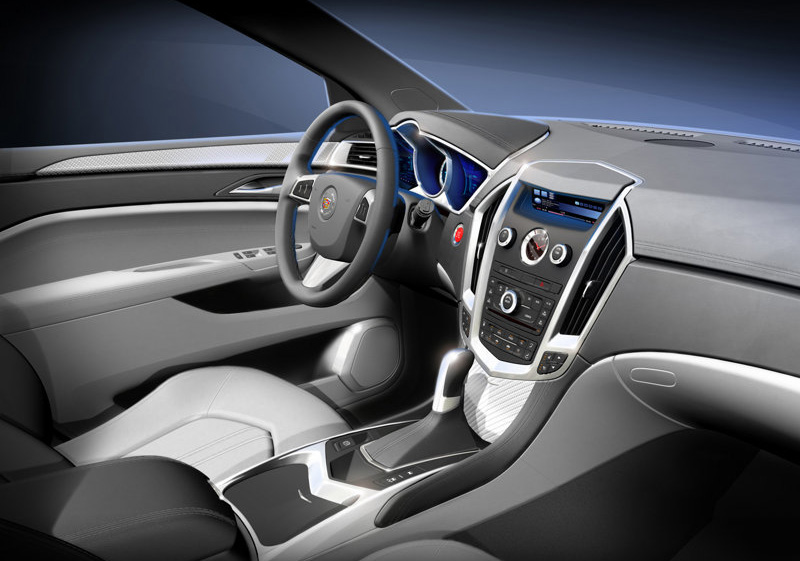
The Cadillac Provoq fuel cell concept is the latest example of GM's groundbreaking E-Flex propulsion system, combining the new fifth-generation fuel cell system and a lithium-ion battery to produce an electrically driven vehicle that uses no petroleum and has no emission other than water. The concept's fifth-generation fuel cell technology is half the size of its predecessor, yet it has been developed to produce more power and performance.
Fuel-cell variant of the E-Flex system
The concept can drive 300 miles (483 km) on a single fill of hydrogen - with 280 miles (450 km) from hydrogen and 20 miles (32 km) on pure, battery electric energy.
A pair of 10,000 psi (700 bar) composite storage tanks beneath the rear cargo floor hold 13.2 pounds (6 kg) of hydrogen to feed the fuel cell stack, located under the hood. There, hydrogen mixes with oxygen to generate electricity - up to 88 kW continuous power. A lithium-ion battery pack can store up to a total of 9kWh of electrical energy and also provides a peak of 60 kW of power for additional performance.
The electricity generated by the fuel cell is distributed to a 70 kW co-axial drive system for the front wheels and individual, 40 kW wheel hub motors on the rear wheels, giving the Cadillac Provoq its all-wheel-drive traction and great driving dynamics. Its 0-60 mph (approximately 100 km/h) speed of 8.5 seconds is a more than 30-percent improvement over the previous-generation fuel cell system and with instantaneous torque to the wheels, it feels even faster. Provoq has a top speed of 100 mph (160 km/h).
Key features
With sleek, signature Cadillac bodywork, the Provoq concept redefines luxury crossovers, offering uncompromising passenger and cargo space to match its performance and cruising range. Additional vehicle features include:
* Solar panel integrated in the roof to help power onboard accessories, such as the interior lights, audio system and more
* Brake-by-wire technology
* Front grille louvers that close at highway speed to enhance aerodynamics, and open at low speed to provide maximum cooling to the fuel cell stack
Highlights include:
* Active front grille, with grille louvers that open when the fuel cell stack requires cooling
* Full underbody aerodynamic cover
* Left- and right-hand charging ports incorporated in stylish front fender vents
* Flush door handles that feature push-to-release operation
* Wind tunnel-shaped outside mirrors with integral turn signals
* Center high-mounted rear stop lamp incorporated into full-width, wraparound spoiler
* Signature vertical taillamps with subtle fin design
* Side glass mounted flush with pillars
* Wheels with clear-covered space between the spokes, creating a sleeker profile while maintaining Cadillac's signature bold wheel design
* Low-drag roof rack
Wednesday, May 5, 2010
Were you, like us, just thinking that BMW's U.S. lineup would be fully complete if only it had just one more crossover utility Sports Activity Vehicle that slotted in somewhere between the small X3 and midsize X5? If so, we have good news. Just such a vehicle – logically and tentatively named the X4 – is rumored to be in development. Again.
Just as the X6 was designed as a sportier take on the more traditional SUV-shaped X5, the new X4 would inject a bit more Bavarian flavor into the plain ol' X3. Citing an unnamed source within the company, Autocar reports, "We haven't made any firm decision... however, the X6's success shows there is a continued demand for sporty off-roaders."
Yes, we've heard this rumor before, but not since 2008. Why the possible change of heart? Despite drawing ire from what seems to be a vocal minority, BMW reports that the X6 is handily outpacing its own initial sales projections. In fact, it's 80,000 sales worldwide is twice what the automaker had expected to sell. And one good turn deserves... something.
[Source: Autocar]

Wednesday, March 24, 2010


 Ferrari 612 Scaglietti one to one, 2008
 Lightweight, simple and striking with a distinctive engine and exhaust sound: every last detail of the Ferrari 430 Scuderia exudes uncompromising sportiness as a direct result of its close links to the world of racing, which is reflected in the car's name: "Scuderia". Seven-times World Champion Michael Schumacher was also involved in the car's development, with the result that the most advanced single-seater technology is now available to Ferrari's sportiest and most passionate clients. With a dry weight of 2775 lb (1250 kg) and 510 hp delivered at 8500 rpm by its naturally aspirated 4308 cm3 V8 engine, the Ferrari 430 Scuderia boasts an extraordinarily low weight-power ratio of just 2.45 kg/hp, which allows it to sprint from 0 to 100 km/h in just 3.6 seconds.
Engine and engine Sound
The Ferrari 430 Scuderia's engine is an evolution of the Ferrari F430's 90° V8 which features a number of modifications to boost its specific power output from 114 hp/litre to 118 hp/litre. The inlet ducts and exhaust system have been optimised, most notably through the adoption of the exhaust geometries derived from the Ferrari F430 Challenge and the use of carbon-fibre on the intake manifold and for the filter housing to aid weight reduction.
F1-Superfast2 Gearbox
The F1-SuperFast2 is an evolution of the F1 gearbox used on all of Ferrari's models and reduces gear-shifting times to just 60 ms, the fastest time of any of the models in the Prancing Horse range, the lowest overall of any automated-manual gearbox. Significantly, Ferrari calculates the gear changing time according to the acceleration gap, not just the time it takes to engage the gear. The various stages are implemented in parallel (non-sequentially). In the case of the F1-SuperFast2, genuinely innovative integrated engine and gearbox management programmes allow the combined disengaging/engaging of the gears to take place partly in parallel with letting the clutch in and out.
E-DIFF2: E-DIFF with F1-TRAC
The E-Diff2 (which is integrated with the gearbox) is one of the primary components which clearly demonstrate the Ferrari 430 Scuderia's links to the track. In use for many years now in Formula 1, it is integrated with the car's stability control system.
The Ferrari 430 Scuderia is the first high performance road car after the F430 to sport an electronic differential. Torque is continuously distributed between the wheels via two sets of friction discs (one for each driveshaft) controlled by a hydraulic actuator.
The amount of torque actually transmitted to the driven wheels depends on driving conditions and brings considerable advantages in terms of performance, direction stability, active safety and handling feedback.
Racing Manettino
The manettino has already featured in several of Ferrari's road cars but the Ferrari 430 Scuderia features the special Racing version which puts the emphasis firmly on track-specific sporty driving and provides the driver with even more choice in terms of the car set-up. With this in mind, the ICE setting available with the F430 has been removed and a new CT- (Traction Control Off) setting has been introduced. This deactivates the car's traction control, but unlike the CST position, retains the safety of the car's stability control system to ensure a level of safety is maintained.
Michael Schumacher made a particularly valuable contribution to this area of the car's development. In fact. he and the car development team worked together to ensure that the Ferrari 430 Scuderia delivers both exceptional performance and fantastic driving pleasure which is within reach of non-professional drivers.
Brakes
The Ferrari 430 Scuderia boasts a specific braking system featuring CCM (carbon ceramic material) discs with specific dimensions to cope with the car's increased performance.
The front discs are now 18 mm larger than those on the F430 and are designed to dissipate the extra heat created by the higher performance and are even more hard-wearing for greater efficiency. These components, together with 6-pot calipers, guarantee blistering performance at all times and, equally importantly, consistently efficient braking during prolonged track use.
 Aerodynamics
The Ferrari 430 Scuderia's external styling has been honed to improve its aerodynamic efficiency by increasing overall downforce whilst still retaining the same drag values as the Ferrari F430. The aerodynamic efficiency of the newly-styled rear diffuser has been enhanced by the addition of a revised profile for spoiler at the rear of the engine cover and by the large venturis that run from the front wheel houses to the rear bumpers, achieving the patented "Base Bleed" effect developed by Ferrari as part of the Ferrari FXX project.
Styling and Personalisation
The Ferrari 430 Scuderia's ultra-sporty character and blistering performance have led to the redesign of many of its exterior and interior styling features. This was done to give the F430-inspired model its own strong personality and to further enhance the aerodynamics of what is a very extreme car.
 The cabin has been inspired by racing and, once again, the emphasis has been on weight reduction and using technical materials where possible.
Ferrari 430 Scuderia Technical Specifications
* Vehicle dimensions
o Overall length: 177.6 in (4512 mm)
o Overall width: 75.7 in (1923 mm)
o Height: 47.2 in (1199 mm)
o Wheelbase: 102.4 in (2600 mm)
o Front track: 65.7 in (1669 mm)
o Rear track: 63.6 in (1616 mm)
o Dry Weight: 2775 lb (1250 kg)
o Kerb Weight: 2975 lb (1350 kg)
o Weight Distribution: 43% Front, 57% Rear
o Boot capacity: 8.83 cu ft (250 l)
o Fuel tank capacity: 25.1 US gal (20.9 UK gal) (95 l)
o Brakes: Carbon-ceramic; Front 15.6 x 1.4 in (398 X 36 mm), Rear 13.7 x 1.3 in (350 X 34 mm)
o Tyres: Front 235/35 19", Rear 285/35 19"
* Engine
o Type: 90° V8
o Bore and Stroke: 3.26 x 3.19 in (92 x 81 mm)
o Total displacement: 263 cu in (4308 cm3)
o Compression ratio: 11.88:1
o Maximum power: 375.4 kW (510 CV) @ 8500 rpm
o Specific output: 118.4 CV/litre
o Maximum torque: 470 Nm (346.67 lb ft) @ 5250 rpm
o Maximum rpm: 8640 rpm (with limiter)
* Performance
o Acceleration
+ 0-62 mph (0-100 km/h): under 3.6 s
+ 0-124 mph (0-200 km/h): under 11.6 s
+ 0 - 1000 m: 20.9 s
o Top Speed: 198 mph (320 km/h)
o Dry weight/Power: 5.4 lb/CV (2,45 kg/CV)
* Electronic Controls
o CST Stability and Traction Control with new traction control logic F1-Trac integrated with the electronic differential (E-Diff)
* Transmission and Gearbox
o Electronic differential: E-Diff2 (E-Diff + F1-Trac)
o Gearbox: F1, 6-gears + Reverse
* Fuel Consumption
o Combined: 15.7 l/100 km
* CO2 Emissions
o Combined: 360 g/km

Wednesday, March 3, 2010


The juxtaposition of headlamp modules with aluminium-finish air-intakes also conveys an impression of fluidity and movement. The two rows of main and dipped beam lights sit on a crystal-like striated strip which fills the sidelight and daytime running light functions.
The headlamps use high-performance light-emitting diodes which are both long-lasting and extremely efficient. The foglamps also employ LED technology and blend harmoniously with the dynamic, front-end styling.
The shoulder-lines flow along the curvaceous sides before culminating in a squat rear-end which expresses power and movement.
The boot, which pulls open and then lifts to minimize vertical travel, echoes the kinematics of the doors which are divided into two sections. The panelled door itself is topped by a separate glazed area and, as they open, the two parts deploy gracefully and elegantly in an independent movement redolent of dragonfly wings. A carbon arm at the rear of the doors connects them to the body structure and the system ensures particularly easy access for passengers.
In addition to its practical aspect, this technological feature reveals a cabin that blends effortlessly with the elegance and energy expressed by the exterior.

This sculptural, one-piece structure, which is finished in fire red lacquer, ensures a seamless link between the exterior and the cabin. The centre console extends through to the rear seats and its layered design recalls the striated bar of the headlamp modules.
The choice of colours and materials is another means by which the exterior and interior have been harmonized to highlight Renault Mégane Coupé Concept's volumes and magic.
The iridescent Dragon Grey body-colour goes well with the dragonfly-like door-opening mechanism and the paintwork's rainbow finish gives a fresh vision of the car every time the light changes: even at a standstill, it appears to be in movement. Meanwhile, the interior's contrasting colour-scheme underpins the dynamic exterior thanks to the blend of fire red lacquer (dashboard, upper part of the centre console, front seatbacks, etc.) and softer black leather or nubuck for the door panels, seat cushions and centre console). The door panels themselves incorporate supple, slide-locking stowage, while the floor is protected by a black, modern, graphic mesh.

The four-zone climate control system allows each passenger to select the temperature they prefer using controls housed either side of the dashboard in the case of the front passengers or on the front seatbacks for rear occupants.
Special care has also gone into ensuring that the cabin is brightly lit. The red backlighting of the instruments contrasts with the surrounding black backgrounds. Meanwhile, the panoramic windscreen extends over the roof to provide additional clarity during the day and blue-hued cabin lighting at night.
Indeed, Renault Mégane Coupé Concept is powered by a 200hp (147kW) 2.0 Turbo petrol engine which delivers torque of 280Nm at 2,600rpm and peak power of 200hp at 5,800rpm to ensure punch and flexibility at all engine speeds for everyday motoring pleasure. Mated to a manual six-speed gearbox, the 2-litre turbocharged unit drives Renault Mégane Coupé Concept from a standstill to 100kph in just 7.2 seconds, yet it returns economical fuel consumption of just 6.5 litres/100km (154g of CO2/km).
Renault Mégane Coupé Concept is a compact, stylish, dynamic coupe which delivers undeniable driving pleasure, while its sporty calling is also expressed by its modern, elegant cabin. This show car, which builds on the trend established by Laguna Coupé Concept, sees Renault take its will to dial genuine passion into its cars yet another step forward.

* Length (mm) 4,514
* Width (mm) 1,908
* Height (mm) 1,371
* Height with doors open (mm) 2,085
* Wheelbase (mm) 2,749
* Front track (mm) 1,658
* Rear track (mm) 1,648
* Front overhang (mm) 950
* Rear overhang (mm) 815
* Unladen weight (kg) 1,310
* Boot volume (litres) 290
Technical data
* Engine 2.0 T petrol (200hp)
* Power (hp) 200hp (147kW)
* Maximum torque (Nm) 280Nm at 2,600rpm
* Acceleration from standstill to 100kph (s) 7.2
* Standard cycle CO2 emissions / fuel consumption 154g/km / 6.5 litres/100km
* Gearbox Six-speed manual gearbox
* with 'stop and start' system
* Transmission Front-wheel drive
* Tyres 245/35 ZR21
* Wheels 21-inch